
The oil arithmetic
Eating healthy.
Still not losing weight?
You could be pouring more than 7,000 extra calories into your pan every month — without ever putting them on your plate.
Added calories / month
1 tbsp of oil, twice a day, for 30 days.
Worked example based on approximately 120 calories per tablespoon of oil. Individual oil use varies.
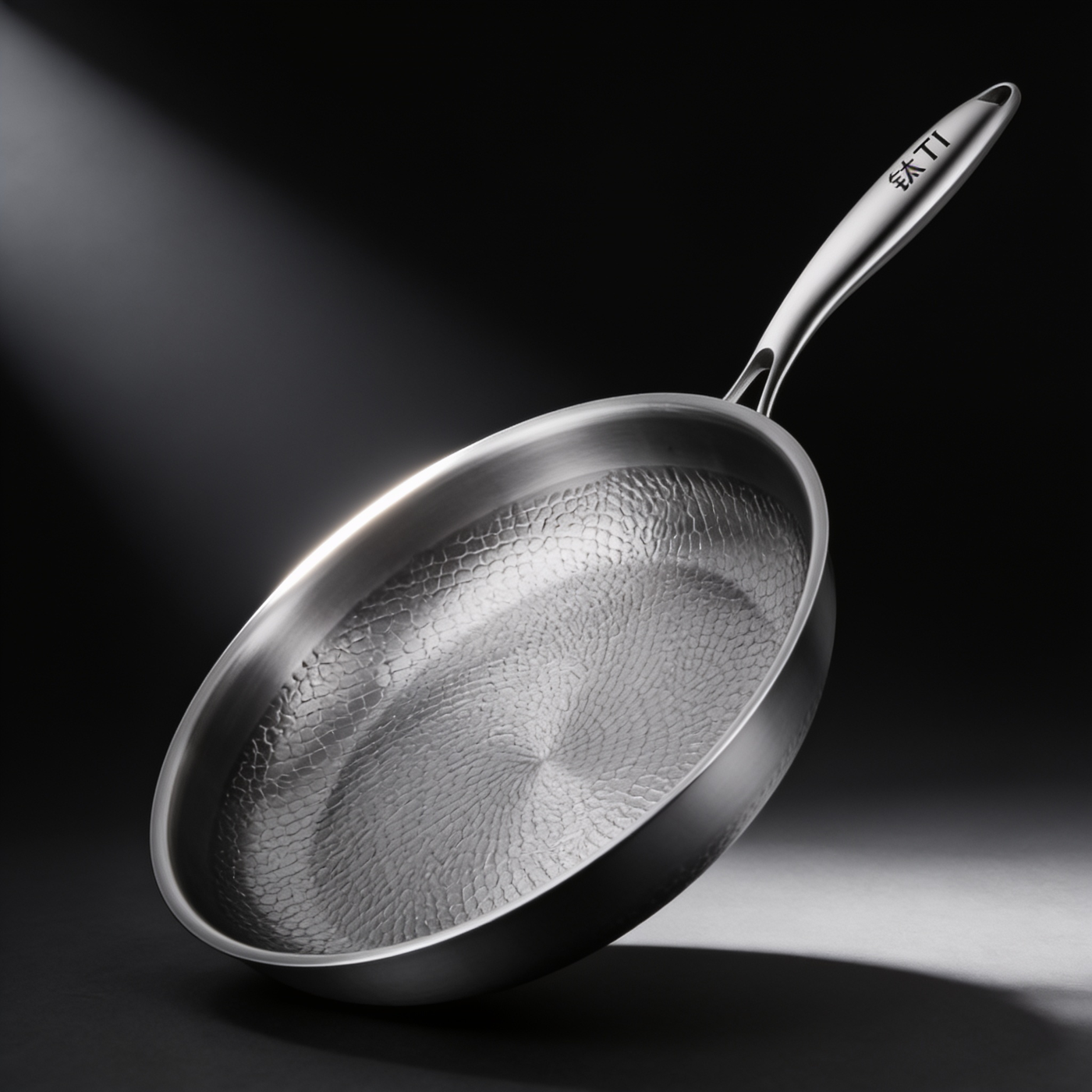
Uncoated titanium cooking surface
Titanium Frying Pan
- A teaspoon of oil does the job a tablespoon does in a regular pan
- Cuts cooking calories without making your dinner any smaller
- No non-stick coating applied — nothing on top of the metal to flake or wear through
- Preheat, a teaspoon, wait for the release — that is the whole technique
30 days to test it in your own kitchen.
What it is
A frying pan with an uncoated titanium cooking surface over a composite multi-layer base. Nothing is applied on top of the metal, so there is no non-stick film that can scratch, flake or wear through.
Sizes: 10 in (26 cm), 11 in (28 cm), 12 in (30 cm).
Why the oil is there in the first place
Oil ends up in a pan for two different reasons. One is flavour — you wanted it. The other is lubrication — the pan needs it, or food welds to the metal.
That second pour is the one worth looking at. It is not there because you wanted the calories. It is there because of the surface underneath.
On this pan, a thin teaspoon does what a poured tablespoon does in a worn-out non-stick pan. Roughly 40 calories instead of 120, per pan-cooked meal.
How to cook on it
Preheat over medium heat for two to three minutes before anything goes in. Never start on high — too much heat is the most common cause of sticking, not too little.
Add about a teaspoon of oil with a high smoke point and tilt the pan so it spreads thin across the base. It should coat the surface, not pool in it.
Then leave the food alone. It releases when it is ready. Moving it too early is the second most common cause of sticking.
Care & cleaning
Let the pan cool for a moment first, then wash with warm water, a little dish soap and a soft sponge. Hand washing is the gentler option and what we would recommend day to day.
If something has stuck, fill the pan with warm water, leave it five minutes, then go back with a soft sponge. Skip steel wool and metal scouring pads.
Never run cold water into a pan that is still hot. Thermal shock can warp any pan, this one included.
The calories you never wanted
Before you eat less,
cut this first.
Most diets start by making your plate smaller. Less bread. Less pasta. Smaller portions. No dessert.
Cooking oil is different. It adds calories without adding any food. A tablespoon goes into the pan so dinner does not weld to the metal, and then it disappears into the meal.
Nobody decides to eat it. It just goes in, because the pan needs it.
Worked example
1 tbsp of oil per pan-cooked meal, two meals a day, thirty days, at approximately 120 calories per tablespoon. Your own oil use will differ.
None of that gave you more chicken, more vegetables, or a bigger dinner. It went in before your food ever reached the plate.
Same food, fewer calories
Same dinner.
Different calories.
The plate does not get smaller. Only what goes into the pan does.

Regular pan — 1 tbsp of oil
+120 cal
Poured in to stop the food sticking.
This pan — 1 tsp of oil
+40 cal
A thin teaspoon is enough for release.
Identical food on both plates. The only variable is the oil added during cooking, at approximately 120 calories per tablespoon and 40 per teaspoon.
Why you don’t need the pour
Your old pan needs the oil.
Your dinner doesn’t.
There are two reasons oil ends up in a pan, and they are worth separating.
One is flavour. You wanted it there. Keep it.
The other is lubrication. The pan needs a film of fat or food sticks to it. Those calories were never a choice you made about your dinner — they are a property of the surface you happen to own.
This pan has an uncoated titanium cooking surface. Bring it up to temperature, add about a teaspoon of oil, and food releases. Not a tablespoon poured until the base is covered. A teaspoon, spread thin.
Use oil when you want the flavour. Not because your pan needs a puddle of it.

Regular pan needs
~120 cal
This pan needs
~40 cal
Difference per meal
~80 cal
Over thirty days
~4,800 cal
Based on 1 tbsp versus 1 tsp of oil per pan-cooked meal, two meals a day, thirty days. A tablespoon is three teaspoons.
Where the calories go
Where would you rather
spend 120 calories?

1 tbsp of cooking oil
~120 cal
Poured in so the food would not stick. You never tasted it as a separate thing.
3 oz of grilled chicken breast
~140 cal
Roughly the same calories. Only one of them is dinner.
USDA FoodData Central: olive oil, 1 tbsp = 119 cal. Chicken, breast, meat only, cooked, roasted, 3 oz (85 g) = 140 cal.
The technique
A different pan.
A simple technique.
Three things, and none of them are hard. They are just not the same three things a non-stick pan taught you.

01
Preheat
Medium heat, two to three minutes, before anything goes in. Never start on high — too much heat is the most common cause of sticking, not too little.
02
Add a teaspoon
One teaspoon of a high smoke point oil. Tilt the pan so it spreads thin across the base. It should coat the surface, not pool in it.

03
Wait for the release
Then leave it alone. Food lets go of the surface when it is ready. Moving it too early is the second most common cause of sticking.
That is it.
Thirty days
A tablespoon doesn’t look like much.
Two pan-cooked meals a day for a month is about sixty tablespoons of oil. That is very nearly a full litre — roughly the bottle you would buy at the shop, poured into your food a spoonful at a time.
At a spoonful at a time it never looks like a decision. Sitting on the counter as one bottle, it does.
Oil over 30 days
~900 ml
Calories in it
~7,200
60 tbsp at approximately 14.8 ml and 120 calories each. A worked example of one usage pattern, not a measurement of anyone’s kitchen.


Before another supplement
Maybe you don’t need another thing to take.
Maybe there is something you can stop adding.
Pills. Powders. Shakes. Teas. Every one of them asks you to add something new to your day, remember it, and keep it up for months.
This is the opposite kind of change. You cook the way you already cook, in a pan instead of the pan you have now, and the calories come out on their own. There is nothing to remember and nothing to keep up.
Less oil. Same food. One change, used every day.
The surface
Nothing is applied on top of the metal.
A non-stick pan works by putting a coating onto aluminium. The coating is what releases the food — and the coating is also what ages. Heat, utensils and time all work on it. When it finally goes, the pan needs oil again anyway, which is how a lot of people end up back at a poured tablespoon without noticing when it happened.
This pan has no non-stick coating applied to the cooking surface. Release comes from bare titanium at the right temperature plus a thin film of fat — the same way a good stainless or carbon-steel pan works. Which is why it behaves the same in year five as it did on day one: there is no layer to lose.
Construction: a titanium cooking surface over a composite multi-layer base for even heat.


Coated pan
Cross-section
Two materials, one seam. The release lives in the top layer, so the release has a lifespan.

This pan
Cross-section
Nothing sits on top, so there is nothing to wear through. The surface you cook on is the metal itself.
Straight about this
This is not a Teflon pan and it will not behave like one. It needs preheating, and it needs that teaspoon. Lean food put into a cold, dry pan will stick to it — the same as it would in stainless steel.
If what you want is to drop a raw egg into a cold empty pan and walk away, buy a coated pan and replace it every year or two. If you are willing to preheat and use a teaspoon instead of a pour, this gives you most of those calories back and keeps giving them back for as long as you own it.
Comparison
Compared on oil, not on fear.
The honest version of this table: a brand-new coated pan beats everything here on oil. The question is what it does in year two.
| This pan | New non-stick | Non-stick, a year in | Stainless steel | Cast iron | |
|---|---|---|---|---|---|
| Oil needed so food releases | ~1 tsp | None | Rising, then a pour | ~1 tbsp | ~1 tbsp, plus seasoning |
| Cooking-oil calories added per meal | ~40 | ~0 | Climbing toward ~120 | ~120 | ~120 |
| Non-stick coating applied | None | Yes | Yes, degrading | None | None — a seasoning layer you maintain |
| Does release get worse as it ages? | No coating to lose | Not yet | Yes | No | No — improves with use |
| Metal utensils | Fine | Avoid | Avoid | Fine | Fine |
| Everyday cleaning | Warm water, soft sponge | Soft sponge only | Soft sponge only | Often needs a scrub | Rinse, dry, re-oil |
Scroll the table →
Oil figures are the typical amount needed for release rather than for flavour, at approximately 120 calories per tablespoon and 40 per teaspoon. Other cookware varies by manufacturer, by age and by how you cook.
Guarantee
Cook without the pour for 30 days.
Try it on the meals you actually make, in your own kitchen, on your own hob. If it does not do what this page says it does, tell us within 30 days of delivery and we will refund it.
Returns within 30 days of delivery.
FAQ
Questions worth asking.
Do I still need oil, or not?
You still use oil — about a teaspoon, spread thin, for most things. This is not a pan that fries a lean egg on dry metal, and we would rather tell you that here than let you find out on your first breakfast. The saving is the difference between a teaspoon and a poured tablespoon: roughly 80 calories a meal, every meal, for as long as you own it.
What heat should I use?
Medium, preheated two to three minutes so the heat evens out before food goes in. High heat is the most common cause of sticking on an uncoated pan — the instinct to turn it up is the thing to resist.
How do I clean it?
Let it cool for a moment, then warm water, a little dish soap and a soft sponge. Hand washing is the gentler option and what we would recommend day to day. Skip steel wool and metal scouring pads.
Something stuck. What now?
Fill the pan with warm water, leave it about five minutes, then go back with a soft sponge. It lifts. Do not run cold water into a pan that is still hot — thermal shock can warp any pan, this one included.
Will it discolour?
Heat can change the colour of bare metal over time, particularly a faint golden or bluish tint around the base. It is cosmetic. It does not change how the surface cooks.
Which sizes are there?
10 in (26 cm), 11 in (28 cm), 12 in (30 cm). If you cook for one or two, the smallest is usually enough; if you cook for a family or want room to move food around, size up.
Returns?
30 days from delivery.
Keep the food.
Lose the pour.
You do not have to eat less to cut these calories. You have to stop adding them.
Calorie figures on this page are worked examples based on approximately 120 calories per tablespoon of cooking oil, not predictions about any individual. This product is cookware. It is not a treatment, and it does not cause weight loss. Any change in weight depends on your total food intake and activity, not on any single product.